#Interview with Wednesday and Knives Out Actor, Riki Lindhome by Lou about her new comedy stage show, Dead Inside, tickets Available Now @rikilindhome #DeadInside

Interview with Riki Lindhome about Dead Inside
By Louise Cannon

photos by ©Elisabeth Caren 2024

Riki Lindhome is perhaps best known for the film franchise, Knives Out, Wednesday,
The Big Bang Theory and more, that will be mentioned later. Among her fans is Michelle Obama. Even with all this, she remains grounded and explains later how that is.
Currently, Riki Lindhome is appearing in theatre (see details after the interview), starring in her show, Dead Inside. A comedy hit at the Edinburgh Fringe Festival, now touring, it tells about the life journey of fertility, freezing eggs, surrogacy and adoption. We talked about this, resilience and hope, being one half of comedy music duo Garfunkel and Oates and of course being part of popular major film/tv/streaming franchises.

Let’s welcome Riki Lindhome to Bookmarks and Stages as she tells us her fascinating, insightful, authentic answers. Thank you to Gingerbread Agency for connecting us.

What or who inspired you to become an actress?

I remember being six years old and seeing a girl who looked like me in a bubble gum commercial. I felt such palpable jealousy every time that commercial came on that I turned to my mom and said, “That’s going to be me someday.” 

You are most widely known for Knives Out” and “Under the Silverlake” and major hit shows “Wednesday”, “The Big Bang Theory”, “Brooklyn 99” and most recently “The Muppets Mayhem”. How does that feel to be part of hugely popular shows and how does this impact your career when you go off to do other types of shows such as your new comedic one-woman musical “Dead Inside” that originated at the Edinburgh Fringe Festival and has now transferred to Soho Theatre, London?

I felt so lucky to be a part of those projects. There’s something very special about being involved in work that people connect to on that scale.

What’s interesting is that something like Dead Inside is almost the opposite experience. It’s much more personal and much more exposed. When you’re part of a big show, you’re one piece of a larger machine. With this, it’s just me, so the connection with the audience is very direct.

I think the two sides actually support each other. The larger projects give me a platform, and then something like Dead Inside lets me define my voice more clearly.

Dead Inside addresses infertility and delves into freezing eggs, embryo implantation, pregnancy loss, undiagnosed medical conditions, surrogacy, adoption.
How important do you think this is to be portrayed on stage and how did you go about infusing it with comedy?

RIKI LINDHOME ©Elisabeth Caren 2024 All Rights Reserved

I think it’s important because it’s something so many people go through, but often very privately. There’s still a lot of silence around it, which can make it feel even more isolating.

For me, comedy was the way in. It allows you to talk about something that might otherwise feel too heavy or difficult. I wasn’t trying to make light of the experience, I was trying to make it shareable. If people can laugh, they’re more open, and that creates space for the more emotional aspects of the story as well.

You have dug into your own life experiences to bring to stage, how did you feel doing this did you have support, if you wanted some?

It was definitely a process. At the beginning, it felt more vulnerable, because I was still very close to the experience. Over time, it became more about shaping the story than reliving it.

I’ve been very lucky to have supportive collaborators and friends who helped me develop the show. My director, Brian McElhaney, said he wanted to direct the show before I even wrote it. I just told him about the idea and he was like, “I want to be a part of that.” Then, Zach Zucker from Stamptown and Alchemation helped me bring it to Edinburgh (also before they saw the show). So I’ve felt very supported in this whole journey, honestly right from the start.  

You emphasize resilience and hope within your show. What does that mean to you and how do you feel it comes across to your audiences so far?

For me, it’s less about a clean, inspirational version of resilience and more about continuing even when things are uncertain or don’t go the way you expected. The experience I went through didn’t follow a straightforward path, and I think that’s true for a lot of people in different areas of life. 

I think what audiences connect to is that it’s not presented as a perfect or resolved journey. It’s more about navigating something complicated and still finding moments of humor and joy within it.

You are one half of musical comedy duo Garfunkel and Oates and have toured the world. Michelle Obama is a fan and you have amassed over 100m hits on YouTube.

How do you stay grounded and how do you use each success to propel you into doing a new show, such as your current one, “Dead Inside”?

It’s been very easy for me to stay grounded because I’ve experienced far more failure than success. But I have been lucky to be a part of so many amazing projects and hopefully, each thing I do makes me more equipped to do the next one. 

Where can people find more info about your show, social media and You Tube channel?

You can find information about the show, tickets, and updates on my website rikilindhome.com, my Instagram, TikTok and Facebook @rikilindhome and my YouTube channel @rikilindhomesongs

Riki Lindholme will be performing Dead Inside at Soho Theatre from 31stMarch – 18th April. Tickets available HERE.
#EdFringe News – Graham Norton Is Appointed as An Ambassador Of The Edinburgh Fringe Festival #GrahamNorton #EdinburghFringeFestival

Comedian and broadcaster Graham Norton named as the newest Ambassador of the Edinburgh Festival Fringe

Globally recognised comedian, author and television presenter joins fellow Ambassadors Brian Cox, Suzy Eddie Izzard and the Edinburgh Festival Fringe Society’s honorary President, Phoebe Waller-Bridge, as Ambassador for the festival

Today, Wednesday 29 October, the Edinburgh Festival Fringe Society is delighted to announce Graham Norton as the newest Ambassador of the Edinburgh Festival Fringe. The role will see Graham act as Ambassador for the festival, alongside previously announced Ambassadors Suzy Eddie Izzard and Brian Cox and honorary President of the Edinburgh Festival Fringe Society, Phoebe Waller-Bridge.

Known for his popular BBC1 chat show, and as the UK’s host for Eurovision, Graham’s entertainment career dates back to 1991 when he was refining his craft as a standup comedian at the Edinburgh Festival Fringe, performing ‘Mother Teresa of Calcutta’s Grand Farewell Tour’ in the Pleasance Attic, a newly opened 60-seat venue at the Pleasance. In the years following he made the move to mainstream television (as priest Father Noel in Father Ted) while still making frequent appearances at the Edinburgh Fringe, culminating in him being shortlisted for the prestigious Perrier Award in 1997.

Launched in 2007, The Graham Norton Show is one of the BBC’s top-rated entertainment shows, with stars from across the world taking to the red sofa every Friday night in what is seen as a key fixture of the network’s programming. Such is Graham’s star power; it was where Taylor Swift gave her first broadcast interview during the release of her recent album.

Graham continues to support the Fringe and returns most summers to watch shows, support friends and check out the next generation of talent making their name at this unparalleled global marketplace for the arts. Graham is also a celebrated author, with several published novels under his belt, and hosts the popular podcast Wanging On with Maria McErlane.

Speaking of the appointment, Graham Norton said: ‘It’s hard to believe that my connection to the Edinburgh Festival Fringe dates back nearly 35 years. As an emerging comedian back in the early nineties, everyone in the industry knew that you had to make the journey to Edinburgh and its Fringe for the opportunities that you have to develop your craft with a live audience, but also to meet and network with the thousands of industry that go there to look for talent.

Through my chat show I meet and talk to those across the entertainment industry every week, and you’d be hard pressed to find someone on the sofa that hasn’t been to the Fringe either to perform or to watch shows at some point in the past. I’m delighted to be announced as an ambassador of the Edinburgh Fringe and look forward to visiting the festival next August.’

Tony Lankester, Chief Executive of the Edinburgh Festival Fringe Society, said: ‘Our Ambassadors represent the critical role the Fringe plays in the lives of so many who got their start on the stages of Edinburgh and, today, are at the top of their game in the world of the arts. Welcoming Graham to the fold is a real pleasure – he is someone who exemplifies the joy and generosity of the Fringe spirit, unapologetically passionate about the arts and a huge advocate of the importance of the Fringe in his own career. As an Ambassador he will be uniquely positioned to help inspire the next generation of artists, and we’re excited to be working with him on this mission.’

#Interview By Lou with the Tony Award Winning Actor, Laura Benanti on new show Nobody Cares @laurabenanti #NobodyCares #comedy in #Soho #London at #Underbelly on 2nd Sept #Theatre

Interview with Laura Benanti
on Nobody Cares

Interview by Louise Cannon
Welcome, Laura Benanti, to Bookmarks and Stages and thank you for the opportunity to interview you.
I am absolutely delighted to interview Laura Benanti about her new show, Nobody Cares, which had a hugely successful run at the Edinburgh Fringe Festival. It has now directly transferred to:
 Underbelly Boulevard Soho, London on 2 September for two performances only.
See after the interview for ticket details.
 
Laura is best known for her show-stealing performance as Louise in Gypsy alongside Patti LuPone on Broadway. For this role, Laura won a prestigious Tony Award.
She is also known for her recurring role impersonating Melania Trump on The Late Show with Stephen Colbert, alongside other major Broadway such as Eliza Doolittle in my Fair Lady and more. She has also appeared in tv shows, such as Nashville, Gossip Girl, The Gilded Age and more…
 
Here’s a little about Nobody Cares before we talk about it interview, finding humour in being a former people pleaser and in the perimenopause, Melania Trump and why she impersonates her, connecting with audiences and more…  The answers are fascinating and insightful.
 
Nobody Cares, is a hilarious, heartfelt, and sometimes brutally honest autobiographical hit charting Benanti’s journey from an 18-year-old ingenue to a recovering people pleaser with all of the missteps and marriages (three!) along the way. Her comedic take on everything from motherhood to perimenopause is yet another star turn.
 
Your show, Nobody Cares had a successful run at the Edinburgh Fringe Festival, you’ve stepped onto the glitzy stages of Broadway, huge tv series and won a Tony. What inspired you to choose the Edinburgh Fringe Festival to showcase Nobody Cares and what did you like most about your time there?
 
I’ve always wanted to perform at the Fringe! Being at a festival full of theatre nerds was a dream come true!
 
2.You bring Nobody Cares to intimate stages, what do you enjoy most about this and are there any challenges, compared to big Broadway stages?
 
I enjoy connecting with the audience in a completely different way. I can communicate with them. It’s a much more relaxed vibe. 
 
3. You bring comedy, ranging from parenthood to perimenopause, they can be inherently funny subjects, but what do you feel is important that we find the humour, even in the most challenging of times of being a women?
 
I endeavor to see the world through the lense of a sense of humor. For me, it’s the only way through. Humor eradicates shame.  
 
4. You tackle being a former “people pleaser”, how did you overcome people pleasing?
 
I’m still working on it! I actively work on it during the show! There are definitely people who come to the show thinking I’m going to sing Broadway music and instead I deliver original comedy and songs that has very adult themes and language. I find myself wanting to apologize to them for that, or wondering what they’re thinking. I have to tell myself to let it go and be present. 
 
5. What’s one of the funniest moments of the peri-menopause? Frankly, I ask as I am one of those women hurtling ever closer to that age and stage of life.
 
I think embracing that you will, at some point, look for your phone and it will be in your hand. Brain fog is real!
 
6. After London, what’s next for you in your illustrious career?

The day after I land I film a few days on a very sweet movie called “the Ditch” and then we take our show to Berkeley, California. 
 
7. On a side note, us in the UK often have an eye on US politics. You’re known for impersonating Melania Trump on the Late Show with Stephen Colbert, which is incredibly funny, even from a single pose. What inspires you to do impersonations and kick ass out of politicians? We also have many comedians doing this, it’s often clever.
 
First of all, I want to apologize on behalf of America that some of us voted for our current POTUS (pervert of the United States. Doing this impression is an act of rebellion and a way to keep people laughing during what is a very serious time. 
 
You can catch Laura Benanti in Nobody Cares by finding out more details and booking here: https://underbellyboulevard.com/tickets/laura-benanti-nobody-cares/


#Interview with Michael Hughes about his play, The Last Bantam @TheLastBantam @GreensideVenue #EdFringe #Theatre #Play #TheLastBantam

The Last Bantam
Q&A with Michael Hughes

Conducted by Bookmarks and Stages – Louise Cannon

Do you know what a Bantam of the First World War is? Whether you do or not, Michael Hughes, writer and actor of The Last Bantam has a lot of fascinating information about them and what it is like to act this play out. He also has interesting things to say about audiences and what he wishes to do with the play after the Edinburgh Fringe Festival.

I, recently had the privilege of interviewing Michael Hughes about his play, The Last Bantem. March downwards on the page to find out the fascinatingly detailed answers to my short, but loaded questions.

The play is on at The Green Venues, George Street, Edinburgh 12:45pm – 13:45pm up to and including Saturday 23rd August. Find the link after the interview for further details…

1 – What drew you to write a play about the First World War Bantams?

Good question! This is where I’d love to be able to say, ‘Well Louise, my grandfather was a bantam’. Sadly, I’d be lying to you if I said that (it would make a great story though!).
I was watching a video on YouTube of a former US special forces soldier interviewing another former special forces soldier. Both men were massively built. Huge shoulders, big arms, no necks. Very big men.

Now, my grandfather, uncle and two cousins served in the military and none o them looked like these guys. It got me thinking: ‘What’s the best size for a soldier?’

I did a little online research and found myself in a forum discussing this very thing. The initial consensus was ‘bigger is better’. Bigger men are stronger, they can carry more kit and they’re more intimidating to the enemy.
Then someone asked, ‘What about the Japanese?’. Someone else asked, ‘What about the Gurkhas?’ And another asked, ‘What about the Bantams?’

Everyone did a double-take at this point, including me. ‘Bantams? What are they?’ That’s when my journey began. I did some more research and discovered that Britain recruited thousands of men between 5′-5’3” during the Great War, those men were called ‘bantams’and there were books written about them!

I promptly hovered up everything I could find on the bantams, beginning with Sidney Allinson’s 1985 book, ‘The Bantams’

I was fascinated to learn about these men and, being a short man myself, inspired by their courage and tenacity in the face of not just physical danger, but also discrimination and prejudice on account of their height.
Regarded as ‘degenerate’ by some because of their short stature, they signed up in their tens of thousands to serve their country.

2 – The Last Bantam is based on real events. What emotions did you feel when creating and acting out the play?

I prefer to say, ‘inspired by real events’ rather than ‘based on’ actually. While there is documentary evidence for a great deal of what happens in my play, there’s a dollop of my imagination in there too!

Researching The Last Bantam, I felt indignation at the way these short men were treated and pride at their achievements.

Acting out the play, I feel a range of emotions, not always associated with the play itself. For example, the other day I felt simultaneously sorry for and irritated by someone who’s position in the room meant they couldn’t easily see my performance. They picked a seat at the end of a row and someone sat down directly in front of them. They could not see me without craning round the person in front. It was the fault of the poor seating layout, but it bothered me that someone who’d invested time and money to see my show could barely see it. I found myself thinking ‘Why don’t you move?!!!’ I even contemplated stopping the show to find great person a better seat, would you believe that? I didn’t of course, but if any of your readers find themselves in a poor seating position, they have my permission to move to a better one. Yes, your movement will be noticed and it will annoy me a little, but knowing you can’t see the show you paid for because of someone in front of you bothers me more.

Move!

There are other feelings I experience though which are entirely play-related. I try as much as I can, not to ‘act’ my character but to ‘be’ my character. When he’s irritated, I’m irritated, when he’s sad, or angry or scared, I’m sad or angry or scared. I summon and use my own feelings when I’m Patrick Michael Wolfe. It’s quite a rollercoaster!

3 – How did you research The Last Bantam?

I read everything I could, and there’s more out there than you might think. In addition to Sydney Allinson’s, ‘The Bantams’, there’s also books focussing on the Manchester bantams as well and the Cheshire Bantams and at least two books on the Battle of Bourlon Wood. I also drew heavily from Maurice Bacon’s, ‘The Blast of War’, a history of the 15th Bantam Battalion, Notts & Derby Regiment. My character, Patrick Michael Wolfe, is based in this battalion and it was hugely useful to know where precisely they were at various points in the war.

The Blast of War is written by Maurice Bacon. His father and grandfather both served in the same bantam battalion and meeting him last year to discuss his book was very special to me.

Interestingly, during the last couple of years there’s been a number of videos on YouTube about the bantams. There’s a very good one by a Youtuber called The History Guy and another called The History Chap. All these videos seem to have emerged over the last couple of years, much as my play has done. Could there be something in the air I wonder!

4 – You’ve taken great care in the detail of the uniform, right down to accessories, such as the watch. How did you source this and was it in easy or challenging process?

I decided right from the start that I wanted to look the part as much as possible. I’m no historian or costume commissar, but whether it’s a play, a tv series or a film, a poor costume undermines everything! If someone doesn’t look like the person they’re pretending to be, if they don’t meet our visual expectations, we find it harder to join them in the world they’re trying to create.

I originally tried sourcing actual British uniforms from the Great War and realised that not only could I not afford to do that, but a 100+ years old garment probably wouldn’t survive too many Edinburgh Fringes!

Instead I purchased reproduction uniform and kit, taking note of advice from re-reactors as to who provides the best quality. Quality was paramount. I wanted a costume I could use in the long term, not something that would fall apart after a few shows. A costume that didn’t just look right, but felt right too. You’d be surprised how many people want to physically touch the fabric of my costume. They want to feel the weight and the roughness of it.

I sourced most of my costume from Soldier of Fortune, an online militaria costume provider. Having purchased my costume I then had to distress it.

My character is meant to have spent to years fighting in France. His uniform should reflect that and it does. It’s dirty and stained and ripped and torn, with many amateurish in-the-field repairs. Holes are patched over and rips crudely stitched back together, as was done in action.

In some respects, the uniform is a metaphor for the man. It’s dirty, worn and damaged, but it’s still functional. It’s still in the fight. One look at the uniform and the audience knows, ‘This man’s been through it’.

Audiences are hugely impressed by my costume. They really appreciate the effort I’ve made to look as authentic as possible. The public appreciates it too and it’s a huge help when I’m flyering, promoting my show. It cuts through the noise of Edinburgh and it makes me smile to know that feature in hundreds of holiday photographs!

5 – The Last Bantam is a one man play, what does it feel like to be
carrying the whole play in your own and asking the audience to imagine
the scene, since there is no scenery?

Carrying the play in my own doesn’t bother me at all. It’s rather liberating actually. I determine the rhythm and pace of it and I don’t have to worry about fellow actors missing their cues, forgetting their lines or falling out with each other. I was in a comedy show once in which my two fellow cast members had a spectacular falling-out and it almost scuppered the show!

Being a self-employed healthcare trainer has also prepared me to be a solo performer. The roles aren’t that different. I arrive at a place, get changed, engage with a group of strangers and leave. And I’ve been doing that 25 years!

6 – You were a copywriter many years ago, what or who inspired you to change career and take to the stage?

I’m actually very, very new to acting. After a career in advertising I became a nurse and have been a freelance healthcare trainer for over 25 years. I remain both a nurse and a trainer but I got into stand up comedy in 2015 doing the open mic circuit as a character comic. When I wrote the first draft of Bantam in 2023 I assumed I’d be performing it myself.

I’m retrospect, my assumption that it would be me might seem a little presumptuous, maybe even arrogant. After all, I had no acting training and had never done anything like this before in my life. But I’d spent 8 years doing character comedy and over 20 years addressing groups of strangers as a trainer. I knew I could learn my lines and deliver them.

Whether I could deliver them well…well that was for the audience to decide!

7 – What’s next for you and your play?

I need to focus on my day job! I’m a freelance teacher in care homes and my first priority when the Fringe is over is to drum up some training business!I

With regards to The Last Bantam,I’d love to tour it. There’s lots of small theatres in London I could take it to, and many farther afield too. It’s all a matter of logistics and economics. I can accept a loss doing the Edinburgh Fringe, but future shows will need to cover their costs.

I also plan on publishing The Last Bantam and would absolutely love to have the story made into other a tv series or a movie. I might get Danny DeVito in board! I wish I was doing this ten years ago. Back then the BBC produced several films and documentaries to commemorate the Great War.
It would have been the perfect time for the bantams!

8 – Where can people follow you On social media?

The Last Bantam can be found on Facebook, Twitter and Instagram.

You can find more details on the Ed Fringe site here: https://www.edfringe.com/tickets/whats-on/the-last-bantam

#Interview by Lou with Max Fulham about his show Full of Ham at #EdFringe @ThePleasance @maxfulhamcomedy #Comedy

Interview with Max Fulham about Full of Ham

conducted by Bookmarks and Stages – Louise Cannon

It gives me great pleasure to welcome Max Fulham to Bookmarks and Stages for a Q&A session on his comedy act, playfully named, Full of Ham.

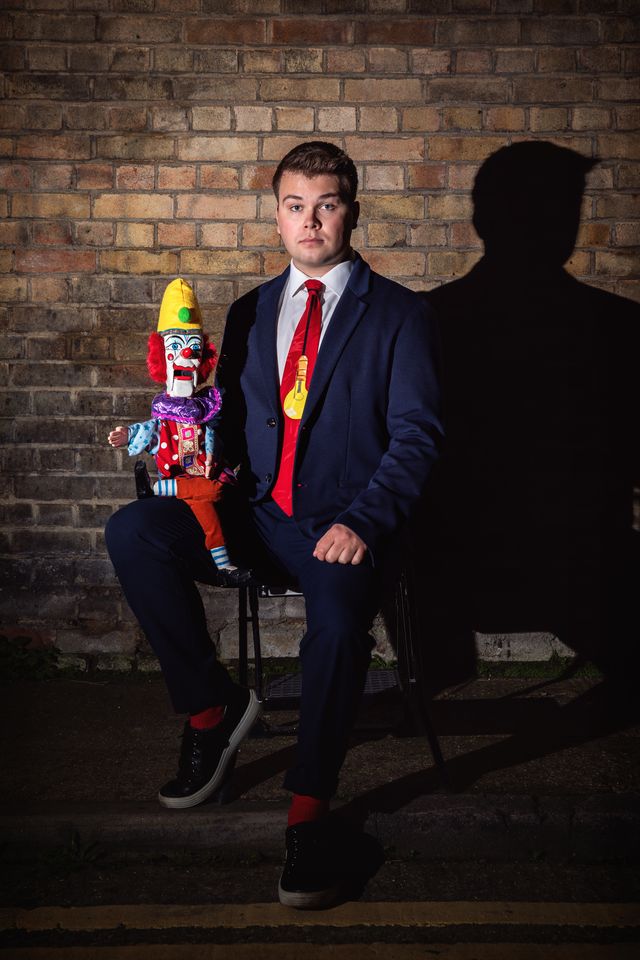
Max Fulham likes to make people laugh through ventriloquism (vent). It’s perhaps not quite all as you’d expect. He has put his own twist on this art-form. He’s worked with some of the biggest stars in show-biz like Craig-Revel Horwood and Mel Giedroyc. He started out in Linlithgow, which is not too far from Edinburgh

Without further ado, let’s find out more through the interview.

You’re known for modernising and bringing new audiences to ventriloquism, but who or what inspired you to take up this artform and create stage shows with it?

How did you train to do ventriloquism?

I taught myself as a child and there was a little worn patch of carpet in front of the mirror in my bedroom where I used to stand and practice. My first puppet was a little pink hand puppet and it was the first of many over the years I asked for for subsequent birthdays and Christmases. It probably took me a few years before I was even half decent and I am grateful I was still a child because being a bit rubbish can be sort of endearing then!

I took up ventriloquism (or vent if you’re really cool) after my parents bought me a puppet for Christmas when I was nine. I have been hooked on it since then! Having done it for a good few years now, one of the things I realised is that a lot of audiences had never seen ventriloquism live before and also had a few preconceptions about it being a bit old and naff. I suppose that is the main inspiration for trying to take it in some new directions or simply to use it to create the funniest things I can. I have been inspired by many of the greats over the years like Ray Alan and Terri Rogers and I think looking back has what has gone before can be a great jumping off point when wanting to take things in a different direction.

Your style is very different from having a dummy on your knee. You’ve decided to create an inner monologue, use inanimate objects and expressions.

What inspired you to do it this way and what themes do you tend to lean towards in this show and why?

It’s fun to play with what people expect from a ventriloquist and twist it into something slightly different. There may be a puppet as you’d expect at one moment but it becomes something unexpected. I have also really enjoyed exploring stuff that doesn’t use a puppet, what happens if there are multiple characters onstage but I’m the only person there? In terms of themes I feel that the show really goes from the everyday to the absurd, from supermarket checkouts to a box full of intrusive thoughts.

You started life in Linlithgow and then headed to clubs and cruise ships, now home to the Edinburgh Fringe Festival. How has your travels influenced what you bring to your shows?

My travels have enabled me to perform for such a wide variety of audiences which is invaluable experience for any performer. What will sometimes work in one scenario will not work in another and I hope that I am slightly better at working that out now after performing all over the place. The vibe I always want to create in my shows is a sense of unity that we are all there in a room and I have some fun things to show you.

Rowan Atkinson, Mel Giedroyc, Craig Revel Horwood and Terry Fator famously highly rate you, which is fantastic. How did that come about and how does this add to shaping your career as you progress ever forwards?

I have been lucky enough to work with or meet some phenomenal people and some true comedy heroes. I worked with Craig Revel Horwood in pantomime last year, he was the Hook to my Smee and we had a great time! I worked with Mel Giedroyc on her show Unforgivable and she has been encouraging me to do the Fringe since then! Getting to meet and work with these wonderful people is often a nice reassurance that I’m getting at least something right… it also looks good on the poster and I’m very grateful for their kind words!

You’re billed to be appearing in Panto with Alexandra Burke and Dr. Ranj, how are you preparing for that and are you able to share what it will be and where?

Yes! I’m off to Neverland this Christmas (read: Southampton). It is shaping up to be a fantastic show from what I have heard in the meetings I have had so far. One of the amazing things about panto though is that it comes together so quickly and we only start rehearsals a week and a half before the show opens so preparations come a lot later in the year!

What’s next for your solo ventriloquism shows?

I would just quite like to continue doing my nonsense and making people laugh. I am excited to see where the characters and ideas from this Fringe show go, I have a feeling a few of them may have life beyond this show!

Where can people follow you on social media?

You can follow me on Instagram @MaxFulham and on TikTok and Facebook @maxfulhamcomedy.

Max Fulham has brought his show ‘Full of Ham’ to the Edinburgh Fringe the August, every night at 6.40pm in the Pleasance Courtyard. For tickets and more information, visit:: https://www.pleasance.co.uk/event/max-fulham-full-ham

#Review by Bookmarks and Stages – Lou of Glass House #EdFringe @GreensideVenue #Theatre @SandCastlesProductions #EdFringe25

Glass House

Review written by Bookmarks and Stages – Louise Cannon

Rating: 5 out of 5.
Set on a bus, Glasshouse is a palpable, powerful play that creates an intriguing, palpable atmosphere on a bus.
 
The bus is caught in a storm and what ensues is evocative and thought provoking. From the outset it has an intriguing, slightly eerie feel as the rain hammers down. On a small stage, there is great attention to detail to make the seats look like the cast are on a bus, right down to what people are wearing, including the driver.
 
From the bus being plunged into darkness, to getting some light, the audience are introduced to the passengers and a rather intriguing storyline as unexpected events unfold when the bus comes to a sudden halt.

It’s worth mentioning before events change further, there is a rather agile dance routine from one of the passengers, which gives the play a bit of a lift, with exaggerated movements as though they are on a bus. There’s also a bit of humour in that and in some of the dialogue.
 
Conversationally, between all the passengers, it feels natural. The writing and acting is skilful to keep it this naturalistic and not purely monologue in nature, although later there is a particularly powerful monologue where you get more insight to a passenger, that works particularly well, both feeding into the story and addressing the audience.
 
If you were on a bus, looking in, you’d see all sorts of people conversing with each other, some listening and others occasionally talking a little over each other. There are also crossed wires, a noticeable glance here, a touch there, creating rising tensions throughout the play, which all becomes quite palpable. This is strong, convincing acting by this young group of actors.
 
What happens next is even more powerful as the intensity ramps up a gear as decisions to be made as to what to do about a homeless person who is on the bus, but is ticketless. The play at this point has then changed into one that’s quite thought-provoking. It makes you question what you would do in this situation.
 
This is a group of young actors who are ones to watch for now and hopefully into the future. The quality of writing and acting are great now and will only increase further. The potential is huge for these students. I’ve seen students perform before and this group are one of the more exciting and I can’t wait to see what their future holds.

The Edinburgh Fringe Festival is the place to see them until and including 23rd August at Greenside Venues on George Street.
Find out more details and how you can get your tickets here: Glass House
 
Synopsis

Sandcastles Productions

Glass House explores the grimy underbelly of the human beast with unwavering intimacy. A boundary-pushing mocku-theatre piece, the play involves pre-recorded interviews with its ‘real-life’ characters as they share their renditions of what happened on the night of February 14th, 2011. The play uncovers how, on a night of unrelenting rain and flooding in the countryside, a stand-off between a stubborn bus driver and a houseless man who can’t afford a ticket slides into a mire of tension and social conflict.