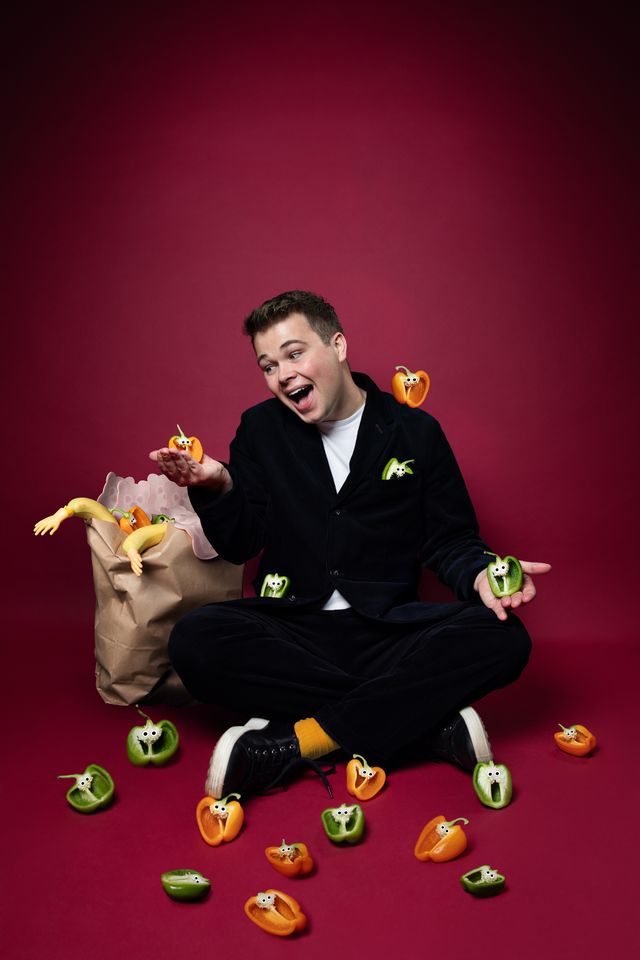
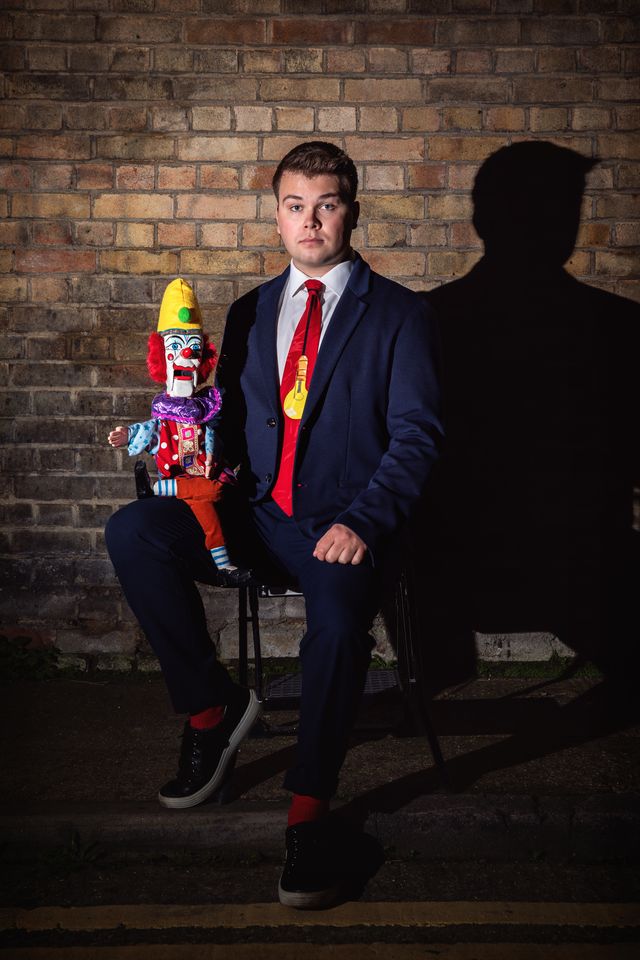
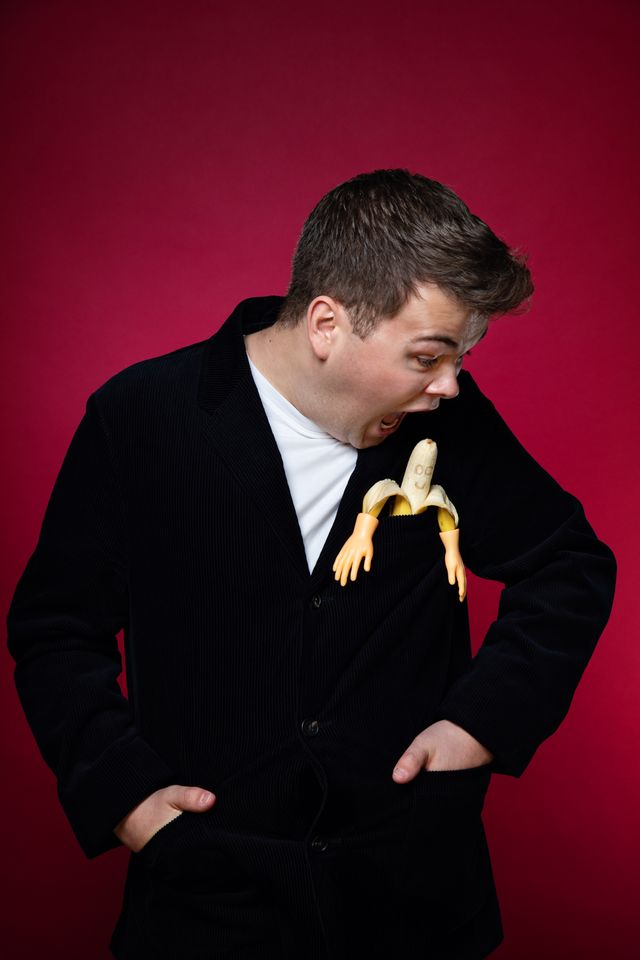
It gives me great pleasure to welcome Max Fulham to Bookmarks and Stages for a Q&A session on his comedy act, playfully named, Full of Ham.
Max Fulham likes to make people laugh through ventriloquism (vent). It’s perhaps not quite all as you’d expect. He has put his own twist on this art-form. He’s worked with some of the biggest stars in show-biz like Craig-Revel Horwood and Mel Giedroyc. He started out in Linlithgow, which is not too far from Edinburgh
Without further ado, let’s find out more through the interview.
You’re known for modernising and bringing new audiences to ventriloquism, but who or what inspired you to take up this artform and create stage shows with it?
How did you train to do ventriloquism?
I taught myself as a child and there was a little worn patch of carpet in front of the mirror in my bedroom where I used to stand and practice. My first puppet was a little pink hand puppet and it was the first of many over the years I asked for for subsequent birthdays and Christmases. It probably took me a few years before I was even half decent and I am grateful I was still a child because being a bit rubbish can be sort of endearing then!
I took up ventriloquism (or vent if you’re really cool) after my parents bought me a puppet for Christmas when I was nine. I have been hooked on it since then! Having done it for a good few years now, one of the things I realised is that a lot of audiences had never seen ventriloquism live before and also had a few preconceptions about it being a bit old and naff. I suppose that is the main inspiration for trying to take it in some new directions or simply to use it to create the funniest things I can. I have been inspired by many of the greats over the years like Ray Alan and Terri Rogers and I think looking back has what has gone before can be a great jumping off point when wanting to take things in a different direction.
Your style is very different from having a dummy on your knee. You’ve decided to create an inner monologue, use inanimate objects and expressions.
What inspired you to do it this way and what themes do you tend to lean towards in this show and why?
It’s fun to play with what people expect from a ventriloquist and twist it into something slightly different. There may be a puppet as you’d expect at one moment but it becomes something unexpected. I have also really enjoyed exploring stuff that doesn’t use a puppet, what happens if there are multiple characters onstage but I’m the only person there? In terms of themes I feel that the show really goes from the everyday to the absurd, from supermarket checkouts to a box full of intrusive thoughts.
You started life in Linlithgow and then headed to clubs and cruise ships, now home to the Edinburgh Fringe Festival. How has your travels influenced what you bring to your shows?
My travels have enabled me to perform for such a wide variety of audiences which is invaluable experience for any performer. What will sometimes work in one scenario will not work in another and I hope that I am slightly better at working that out now after performing all over the place. The vibe I always want to create in my shows is a sense of unity that we are all there in a room and I have some fun things to show you.
Rowan Atkinson, Mel Giedroyc, Craig Revel Horwood and Terry Fator famously highly rate you, which is fantastic. How did that come about and how does this add to shaping your career as you progress ever forwards?
I have been lucky enough to work with or meet some phenomenal people and some true comedy heroes. I worked with Craig Revel Horwood in pantomime last year, he was the Hook to my Smee and we had a great time! I worked with Mel Giedroyc on her show Unforgivable and she has been encouraging me to do the Fringe since then! Getting to meet and work with these wonderful people is often a nice reassurance that I’m getting at least something right… it also looks good on the poster and I’m very grateful for their kind words!
You’re billed to be appearing in Panto with Alexandra Burke and Dr. Ranj, how are you preparing for that and are you able to share what it will be and where?
Yes! I’m off to Neverland this Christmas (read: Southampton). It is shaping up to be a fantastic show from what I have heard in the meetings I have had so far. One of the amazing things about panto though is that it comes together so quickly and we only start rehearsals a week and a half before the show opens so preparations come a lot later in the year!
What’s next for your solo ventriloquism shows?
I would just quite like to continue doing my nonsense and making people laugh. I am excited to see where the characters and ideas from this Fringe show go, I have a feeling a few of them may have life beyond this show!
Where can people follow you on social media?
You can follow me on Instagram @MaxFulham and on TikTok and Facebook @maxfulhamcomedy.
Max Fulham has brought his show ‘Full of Ham’ to the Edinburgh Fringe the August, every night at 6.40pm in the Pleasance Courtyard. For tickets and more information, visit:: https://www.pleasance.co.uk/event/max-fulham-full-ham
Nathan Scott-Dunn and Stirling Sands about Hibernian FC and much more…
interview by Louise Cannon – Bookmarks and Stages
There’s more to the Off Westend Award Winning play, 1902, than football, as I discovered whilst asking the questions. As much as it is celebrating 150 years of the club, Hibernian FC, we also talked about other themes, such as toxic masculinity, using music in such a play, reflecting working class.
What makes Hibernian FC, Hibs so special that you chose to create a play with this particular football club at its centre? Hibernian FC is deeply woven into the identity of Leith and its people. It’s not just a team, it’s family, tradition, and home. For generations, supporting Hibs has been passed down like a birthright. That sense of loyalty, of clinging to hope in the face of disappointment, was what really drew us in. The 2016 Scottish Cup win, after 114 years, was a moment that felt like something more than football. It was a collective emotional release, a victory for everyone who had ever believed through all the heartbreak. 1902 uses that moment as a backdrop, not to tell a story about football, but to explore the lives and relationships of the people who live for it. It’s about community, resilience, identity, and how something as simple as a match can carry so much emotional weight for working-class people who don’t always feel represented in mainstream narratives.
How do you feel toxic masculinity can change and how do you deal with this to make an impact in your play?
Toxic masculinity changes when we make space for vulnerability and when we show that there are other ways to be a man than the one-dimensional, emotionally repressed version we’ve been sold. In 1902, we look at masculinity in a very real, grounded way. These characters argue, lash out, make mistakes but they also cry, admit fear, and support each other in quiet, powerful ways. The play doesn’t lecture, it reflects. We see how bottled-up emotions, shame, and societal pressure affect working-class men who’ve grown up being told that showing weakness isn’t an option. Through their interactions, especially in moments of conflict and intimacy, we show that emotional honesty can exist within these tough exteriors. The goal isn’t to preach, it’s to represent, and in doing so, invite empathy and change. We’re trying to open up a conversation about how men can still be strong while being emotionally present and accountable.
What genre(s) of music do you use in your show and how did you choose what to put in it?
The music in 1902 is deeply rooted in identity and place. At the centre of it is the music of The Proclaimers, which we use to underscore the entire show. Their songs aren’t just a soundtrack, they’re the emotional heartbeat of the piece. Being from Leith themselves, The Proclaimers’ music captures the spirit, struggle, humour, and heart of working-class Scotland in a way that’s unmatched. Their lyrics speak directly to themes of home, belonging, loyalty, and love, all of which are central to 1902. Their songs allow us to move fluidly between moments of tension, reflection, and celebration. They help us create atmosphere, elevate emotion, and at times give the audience space to breathe or reflect. The music is woven into the fabric of the show, not tacked on, but lived in by the characters. Alongside that, we also use authentic Hibs football chants throughout the play. These are the songs you hear in the stands, in the pub, on the streets, full of energy, defiance, and unity. The chants bring the community to life on stage and act as a powerful form of collective expression. For the characters, they’re a release; for the audience, they’re instantly recognisable and deeply nostalgic. Together, The Proclaimers’ music and the Hibs chants create a soundscape that’s unmistakably local, emotionally charged, and completely immersive. It’s not just about setting the scene, it’s about capturing the soul of a community.
What research, if any, did you do so the working class in Scotland is portrayed accurately and so everyone can recognise it.
A lot of the work came from lived experience and working closely with people from the communities we’re representing. This wasn’t about imposing a narrative, it was about reflecting one. The script was developed through workshops, conversations, and a lot of listening. We made sure the dialogue was honest, not softened for a wider audience, but kept true to how people actually speak in working-class communities. That includes the humour, the swearing, the silences, and the things that are said without being said. We also paid close attention to the cultural references, the emotional rhythms, and the socioeconomic pressures that shape daily life, from debt and employment struggles to family responsibilities and unspoken expectations. Every detail was considered so the people who live this reality can watch the show and feel recognised, not stereotyped.
How important do you feel that the working class is represented in theatre and the Edinburgh Fringe Festival in particular?
It’s absolutely essential. The working class has historically been underrepresented or misrepresented in theatre. When they do appear, it’s often through a middle-class lens, which tends to flatten the complexity and dignity of working-class life. At the Fringe, which can sometimes feel dominated by shows that are inaccessible either financially or culturally, it’s even more important to create space for stories that reflect real people’s experiences. Representation isn’t just about visibility, it’s about ownership. It’s about giving working-class artists the opportunity to tell their own stories on their own terms. 1902 is part of that effort. It’s theatre rooted in lived experience, told in a language and setting that working-class audiences can connect to. It’s also about making theatre feel like a place where everyone belongs, not just those who can afford a £20 ticket and a glass of wine at the interval. Our ticket prices have remained the same since our inception in 2017 ensuring everyone can access our shows at an affordable price.
We post regular updates, behind-the-scenes content, and info about upcoming shows, and we always love hearing from audiences who’ve connected with the work.
Interview with Alex Prescot By Louise Cannon – Bookmarks and Stages
Welcome Alex Prescot to Bookmarks and Stages to talk about your new comedy show at the Edinburgh Fringe Festival: Alex Prescot: Cosy, which runs until 25th Aug at 11:45am to 12:45pm.
Alex Prescot has created a “tailor-made show for each audience.” He also says you can “expect a warm and fuzzy blend of joyful musical comedy and quick-witted improvisation.“
Here we talk about becoming a comedian, the show, Cosy, improvisational comedy and more… Some people may know Alex Prescot around the Fringe already from the sell-out show, A Jaffa Cake Musical.
Who or what inspired you to become a comedian?
When I was younger, I wanted to be an actor since doing loads of youth theatre and school plays (classic). Then I went to university and decided I wanted to be not just an actor, but a director and writer too (having studied…French and Spanish). After uni, I moved to London and started to do double act comedy with my mate Nick (another wannabe actor, big ick) until we broke up cause he moved to Australia, I had to go solo and write a debut musical comedy hour about…my double act partner leaving me for Australia.
Improv is, like all comedy, a skill. What attracted you to improvisation in-particular and how did you learn to do this and hone your craft enough to be shortlisted and finalist in comedy awards?
I started doing improvised musicals at uni because all the kids I thought were cool from the musical theatre society were doing it (spoiler: they were not “cool” as the word is widely understood).
After graduating, I co-founded ‘The Bean Spillers’, a small cast improvised musical inspired by audience gossip, but occasionally started cheating on that show with solo musical improv.
As for learning to do it, I really believe it’s hours on the treadmill and watching/listening to your performances back to try and get better. There are also general things I believe makes better crowd work improv: being genuinely interested in the audience, making them the heroes (unless they’re proper twats), and recognising when something is ‘shiny’ and grabbing onto it immediately.
There’s a lot of improv at the Edinburgh Fringe Festival. What sets your show, COSY, apart from the rest?
There’s a fair bit of improv in my show but it also tells the story of my double act break-up and so I’d like to hope it has real heart at its core (something I’ve worked on extensively with my director, the brilliant Ben Target). So hopefully it is different from purely skill-based improv shows (which are great!) and offers something a bit more personal too.
But if you’re an improv nerd and looking for an improv-focused answer, what sets it apart is I am both improvising piano and singing at the same time.
What is the cosiest part of your show? The cushions! I have like 20 as part of the set and I give them out to audience members throughout as rewards for good behaviour.
Why did you choose the Edinburgh Fringe Festival for your show and what happens next?
I am also in ‘A Jaffa Cake Musical’ which had a really great sell-out run last year so has returned this year (and, miraculously, is selling out again!). As I knew this show was coming back, for me it was a no-brainer to debut this year, as the support of a successful musical and my fantastic cast mates from that show has made my Fringe immeasurably better.
As for what’s next, I would love to do a UK tour of this show and maybe also take it further afield too…watch this space!
Where can people follow you on social media?
I’m on everything @alexpcomedy and regularly post clips of the best audience interactions – come along and join the fun!
Interview By Lou with Julie Lake and Annie MacLeod of Forget Me Not
Welcome to Bookmarks and Stages to talk about your fascinating show, Forget Me Not, which you’re performing at the Edinburgh Fringe Festival.
If you’ve ever watched Orange Is The New Black, then Julie Lake would be a familiar name. Since then she’s been more a creator of work on-screen and in music. Annie MacLeod is and award-winning music and songwriter. Together, they talk about their show Forget Me Not, motherhood, being in their 40’s and re-inventing themselves and more… Here’s the synopsis of Forget Me Not. You can find the Edinburgh Fringe link to their show at the end of the interview.
Synopsis
Orange is the New Black’s Julie Lake and songwriter Annie Macleod join forces in Forget-Me-Not, a true story of motherhood, lost love and hauntings set to original music and heart-exploding harmonies. Two estranged childhood best friends reconnect in midlife – both mothers, stifled by traditional roles and longing for more creative freedom, adventure, sexual liberation and a deeper sense of self. Through storytelling and song, they rediscover the power of their bond, finding the healing and freedom they’ve been searching for all along. A moving, magical celebration of motherhood, creativity, resilience and the transformative power of female friendship.
Now, let’s check out he interesting answers they gave about their show and more…
Julie Lake: Who or what inspired you to act and how have you seen your career progress from being in the successful, Orange is the New Black?
I caught the acting bug at five—I wanted to be wild and expressive, but also connect with people in a way I couldn’t offstage. I was shy, secretive, and terrified of revealing too much. Writing used to scare me—I thought it might expose me as crazy or stupid. But since Orange is the New Black, I’ve shifted into creating my own work: pilots, screenplays, music—and now a live play. Turns out, sharing my inner world isn’t fatal. Just… occasionally awkward.
Annie MacLeod: You’re an award-winning music and songwriter. What or whom inspired you to take this career path?
I’ve loved music and theater since high school – Julie and I performed together as teenagers, and I always dreamed of being on Broadway or performing as a musician. But I took a different path, became a nurse practitioner, and poured myself into caregiving and motherhood. For years, I made music in the cracks of my life, stealing moments when I could. But once my kids were out of the baby phase, I had this wake-up call—like, what happened to my dreams? I knew I needed to reclaim them. Our play tells the story of that transformation.
Julie Lake: The play explores motherhood and the complex privilege and joy surrounding this. How would you describe the complications and what is it about this that makes it important to highlight?
When I became a mom, I slipped into a role that didn’t feel like me. I’d been a lifelong artist—filming a pilot at eight months pregnant that got into SXSW. But after my son was born (and then Covid hit), I disappeared into nonstop caregiving. I cried if I left him for an hour. I was secretly writing music, but had lost the courage to share it. I thought it was all over. Annie helped me find myself again. She saw me when I couldn’t. My song “Oldest Friend” says it best: “Be my witness when the fog becomes too thick, when I can’t see beyond these lines. Tell me something, that you see in these dry bones, when my worn heart has lost its shine.”
Annie MacLeod: How did you come up with lyrics and music to convey the complexities of motherhood, so the story really penetrates into you audiences? There’s a song in the show called TheSacrifice that poured out of me during a time I was reckoning with how my own mother’s pain shaped my experience of motherhood. My dad left when I was a baby, and my mom—who struggled with depression—sacrificed everything to raise me. But in the process, she gave up her own desires, her light. I grew up thinking I had to shine bright enough for the both of us. That sadness, that ghost of unfulfilled womanhood, made its way into how I mothered. Writing Sacrifice was the only way I could process it—through poetry and music. The song helped me turn something generational and heavy into something healing. “I am your lifeline, but I’m not drowning too. You say, I come from you. Oh, I come from you.” That’s what I want to offer my kids—and maybe the audience too.
Julie Lake: What is your acting process to convey the theme of grief of futures so the audience can feel something of what you feel and get the point across about this?
Honestly, I just hope I can get through the show without crying too much. I want the audience to really hear the story and feel their own feelings—not mine. So while I’m performing, I’m often trying to hold back. The truth is, there’s no way to fully explain in words or tears the depth or duration of what Annie and I went through. All we can do is tell the truth of what happened and trust the audience to connect it to their own experiences. And the songs do a lot of the emotional work for us, too – they’re really the emotional landscape of this show.
6 . Julie and Annie Re-invention is a big and fully loaded theme running through the musical. How complicated do you think it is to re-invent yourself in your 40’s, what are the positives and the challenges?
Both of us made big shifts in midlife—Annie left her career as a nurse practitioner to pursue music full-time, and Julie leaned into song-writing and performing her own music for the first time at 40. Doing this as mothers was especially hard. Our culture treats anything outside caretaking or earning money as selfish—but it’s not. Reclaiming your wholeness, your voice, your creativity, is one of the best gifts you can give your kids. It’s modelling. We want our children to see what it looks like to live in alignment, not abandon yourself. That’s not selfish—it’s brave, and it’s deeply loving.
Julie and Annie: What do you hope the audience will gain from watching your show?
We hope audiences—especially mothers—leave our show feeling seen, inspired, and reminded of their creative spark. Forget-Me-Not is a love letter to the parts of ourselves that get buried in caregiving, shame, and self-doubt. We want women to feel less alone in their struggles and more empowered to reclaim their voices and dreams.
We’re also launching workshops and women’s circles specifically for Artist Mothers—to keep this conversation going beyond the stage. It’s about building a community where creativity and motherhood can coexist.
Julie and Annie: What inspired you to take your musical to the Edinburgh Fringe Festival and what are you excited most about?
Julie: I’d always wanted to go to the Edinburgh Fringe Festival, but I thought that ship had sailed, that I was too old. But when we started to conceive of this show, it just came to me again, that we could apply at least? And then when we got in I flipped out, I’d have to leave my babies to do it, face so many fears, play my music for people for the first time, but I knew in my gut it was the right next step for us. And I know we would have never made this show without the looming deadline of the fringe. It was too hard, too much work, too emotionally taxing, I mean we did 30 drafts, composed 6 songs, staged the play in NYC with our magnificent director, Peter Cook (Never Sleep Alone). I’m so proud of this show that we’ve created, and whatever else happens at the Fringe is just gravy at this point.
Forget-Me-Not runs August 1–9 at Greenside @ George Street 11:40AM.
Interview hosted by Louise Cannon with Comedian, Robyn Perkins and Psychologist, Dr. Carolyne Keenan Shrink Wrapped: A Psychologist Analysis Live On Stage
Comedy For The Curious – Shrink Wrapped The Lounge at Laughing Horse @ The Counting House 31 Jul – 24 Aug 20:45 1 hour
Welcome, Robyn Perkins and Dr. Carolyne Keenan to Bookmarks and Stages. Thank you for your time in answering all my questions in an in-depth, fascinating manner.
Robyn Perkins is a multi-award winning comedian with hit shows such as Comedy for the Curious. She is said to like investigating life. She tackles big emotionally charged subjects and brings it back to the audience with relatable humour and anecdotes.
Dr. Carolyne Keenan is a fully-qualified, licenced, registered psychologist who is founder and clinical director @ Lotus Psychology Ltd. She has also featured on BBC Radio 1 in programmes such as the popular, Life Hacks, The Independent, Psychology Today and more…
The idea of bringing comedians on-stage together in a group therapy type of scenario, with a psychologist really analysing them, sounds a fascinating and original show. It’s a pleasure to interview you both about this, covering what you hope audiences will get from this, what psychologists really think of clients and so much more… The answers truly are fascinating and insightful. Firstly, we will check out the synopsis and then on to the Q&A before details on where you can catch Shrink Wrapped in Edinburgh.
Ever been deep in a therapy session and gone: I want to know what the hell she’s thinking? Well now’s your chance… with comedians in the hot seat. Join award-winning comedian Robyn Perkins and real-life psychologists (Dr Ruchi Sinha, Dr Carolyne Keenan or Dr Edel McGlanaghy) for the most entertaining therapy session you’ll ever witness. Guest comedians perform their best material, before submitting themselves to gentle psychological probing in front of a live audience. Don’t worry, we’ve got more safe words than a BDSM convention.
Without further ado, let’s begin with the questions I have for you:
Robyn, What gave you the idea to have a comedy show around the topic of therapy and then add in real psychologists into the mix?
It actually started in Adelaide when I had one of our psychologists on Comedy for the Curious (my science comedy panel show, also in Edinburgh). During the show, the psychologist (Dr. Ruchi Sinha) just read all of the comedian guests, from a psychological point of view. After the show, we chatted about how that would make an incredible show on its own, and the raw idea was born. From there, I have developed the idea into a full-blown panel show, developing the structure into what it is today.
Dr. Keenan, how did you become involved in this show and how is it being in the mix of a comedy show and at the same time giving your psychological opinion in front of a live audience?
I was invited to be part of Shrink Wrapped because I had already been a guest expert on Robyn’s show Comedy for the Curious. We had been working together for a while when Robyn came up with the concept for Shrink Wrapped. I’ve always believed psychology shouldn’t just stay in clinic rooms or textbooks, it should be part of everyday life. When Robyn described the show and the concept of combining comedy with psychological insights, I thought it was brilliant.
Being part of a comedy show is exciting and I love meeting all the comedians. It’s different from my therapy work but it uses the same skills- listening deeply, noticing patterns, and reflecting back what I hear. The difference is that on stage, we’re exploring these insights with humour, warmth, and openness in front of a live audience. I love that it makes psychology accessible and fun, while also highlighting the very real human truths that comedy often touches on.
Dr. Keenan, can you give an example of what do psychologists think of their clients, since that is a little of what’s billed in the show that makes it sound so interesting?
People often wonder what psychologists really think about their clients. The reality is, we’re human and often I’m thinking very similar things to what you might be:
“I wish they could see how great they are.”
“They really need to get rid of this idiot, they’d be so much happier.”
“I wish they would focus less on how much their favourite influencer has helped them and give the sessions we have been having some credit!”
In Shrink Wrapped, the audience gets a playful glimpse into how psychologists analyse behaviour and language. For example, a comedian might make a joke about not feeling good enough growing up and I might explore whether that contributed to their attraction to a job where they are constantly seeking immediate and positive approval from an audience. It’s done with kindness and humour though, not judgement, which is what makes it so engaging.
Robyn, Shrink Wrapped has done hugely well at the Adelaide Fringe having sell-out shows. What can people in Edinburgh expect and what do you hope they take away with them at the end of the show?
The concept of Shrink Wrapped seems to intrigue most people, but I think it is the structure behind it that gives the show it’s depth. I have worked with a few psychologists to refine a list of topics we explore across the shows (eg. Conflict, Trust, Romantic Relationships, etc.). Each show tackles a few of the topics in a group therapy session between 3 comedians and a psychologist.
Because the discussion is based in real therapy concepts, the show inherently flips between serious and funny, emotional and light hearted. Equally, I have chosen comedians who are, by nature, quite vulnerable on stage so the chat will occasionally reach emotional moments. However, with 3 comedians on stage at one time, this also means we are desperate to crack a joke if it gets too intense. It is the ebb and the flow of these moments that really makes the show special.
Additionally, since we are talking about real events and real people, we have found that audiences relate to at least one of the comedians on stage, in an ‘I do that’ or ‘that’s me’ kind of way. We are hoping that this can also spark conversations about mental health in a positive and fun way. I know using humour to explore mental health is not a new concept, but watching 3 comedians talk about their mental health in the form of a live therapy session is new territory we are excited to be exploring.
This year in Edinburgh, we are doing the Free Fringe (free entry with donations after the show), and while you cannot book ahead, based on feedback we have had about the show, we are expecting to be just as busy as Adelaide.
Dr. Keenan, what do you hope the audience will have learnt and take away with them by the end of the show?
I hope the audience leaves with:
A sense of relief – realising we all have quirks and struggles, and humour can be a brilliant way to explore them.
A new curiosity about themselves and others – understanding that behaviour always makes sense when you look deeper.
A feeling of connection – seeing comedians open up about their lives helps us feel less alone in our own messy human experiences.
Ultimately, I want people to feel entertained, uplifted, and inspired to reflect on their own lives with more compassion and humour.
For both Dr. Keenan and Robyn, how did you convince 8 comedians to be on stage doing some form of group therapy with 3 psychologists present. Was this an easy or hard task to do?
Dr. KEENAN: I think comedians are naturally curious and brave, they’re used to being vulnerable on stage and they quite like talking about themselves! When they realised this show wasn’t about picking them apart but about exploring their material and personalities in a fun, supportive way, they were on board.
Also, Robyn’s energy and the framing of the show as “science comedy” rather than “group therapy” helped. It wasn’t about fixing them – it was about exploring some of their material through a psychological lens. That made it feel safe and exciting rather than threatening.
ROBYN PERKINS: Similar to what Dr. Keenan has said – as a comedian we love talking about ourselves! But more than that, comedians are curious by nature. I have been overwhelmed by the number of comedians who have asked to be on the show. It’s been fantastic! No convincing necessary!
For both Robyn and Dr. Keenan, what did you both learn from doing this type of show that you would take forward into your careers moving forward and would you do something similar again in the future?
Dr. KEENAN: For me, it reinforced how powerful humour is in making psychological concepts accessible. People learn best when they’re engaged and laughing. I also learnt that psychology belongs everywhere – not just therapy rooms but in arts, media, and entertainment. I regularly take part in BBC Radio One’s Sunday evening show Life Hacks where we take topics that impact the listeners and explore the psychology behind them. We often have call in questions so I’m comfortable thinking on my feet and making these insights accessible and actionable but doing it in front of a live audience on stage has helped me practice those skills and feel even more comfortable with it.
I’d absolutely love to do something similar again. Bringing psychology to audiences in creative ways is something I’m deeply passionate about, and Shrink Wrapped has been a perfect example of how that can work- long may the show continue!
ROBYN PERKINS: I have learned I probably need to do more therapy! I have actually learned a lot about myself, both from comments about me and my set, but I’ve also learned things from watching others. I am hoping this show continues far into the future.
What made you choose Edinburgh Fringe for Shrink Wrapped and what are your plans for where this show can go next?
I go to the Fringe every year, and do the global festival circuit, so it was a no brainer to bring it to EdFringe! Through at least December, we are performing monthly at Top Secret Comedy Club in London at the moment. We will bring the show back to Australia next year. But also, we are looking to potentially start touring the show around theatres and the rest of the UK. The possibilities are endless!
Today, I have the privilege of interviewing Brandon Bernath about new short film/music, Illionaire. It has been screened as part of the Dallas International Film Festival and at SXSW London. We also talk about inspiration, influences and what he is doing next, which sounds an exciting opportunity with his band, THE ABOMIC TOMS, which have featured on the BBC. Their most recent single, “RUN” landed placement in Amazon Prime’s hit new action/drama series, “Motorheads”. There are also links at the end for how you can see the film…
Brandon Bernath an accomplished writer, director, actor, producer, and musician based out of Los Angeles.
He has appeared in films such as “Queen Of Manhattan” alongside Rainey Qualley, (“Delilah”), Taryn Manning (“Orange Is The New Black”), & Drea de Matteo (“The Sopranos”) and “Shot In The Dark” with Jacqueline Toboni (“Grimm”), Austin Hebert (“Jack Reacher: Never Go Back”) and more… Brandon was nominated for Best Actor at the 2017 CineFashion Film Awards for his role in the comedy short “The Selfie That Changed The World”.
He has been recognized in numerous publications for his work, including Rolling Stone Magazine NPR, & American Songwriter Magazine. He has collaborated with major brands and companies such as,L’Agence, Choose Love, Warner Records and more… Brandon’s next project includes creating a series of shorts for the online fashion brand Vague Studios.
So, without further ado, let’s get down to business with the interview.
Brandon Bernath, who or what inspired you to become a director writer, producer, actor and musician and how do you manage to pull all those passions and talents together to make them work for you?
BB: I am a director, writer, producer, actor, and musician. I fell into acting at a young age and then pursued my studies in college and then law school. Coming back into acting 7 years later was a big struggle and forced me to create my own projects to star in, which led me to pursue more directing and producing opportunities. I am a project based artist. I find it easy to multitask in the mediums of art. Whatever the project is I find it natural to pivot to another medium if needed.
Your latest film, Illionaire follows rising New York rock and roll musician, Zoe Fromer and 3 demons in pursuit of Illionaire. How did you come to calling it Illionaire?
BB: Illionaire is the title of Zoe’s song.
The first time we see Illionaire, he is like a comic book character/hero in look and the way he acts. What inspired this characterisation?
BB: I have a deep desire to create real life looney tune characters that are relatable. I am deeply influenced by American genre films and American aesthetics.
You play with surrealism and humour in the acting that then turns into a rock music video like in feel and look. How did you arrive at the decision of this genre to play out the storyline?
BB: The genre is a surrealist comedy with sci-fi elements. I feel that is my aesthetic that I am exploring at the moment; a larger than life absurdist viewpoint based on American tropes, like greasers, burgers, fast cars, shiny colors, and rock and roll.
What is next for you and your very varied career?
BB: I am writing, directing, and producing more short content for fashion brands. I am finishing a feature script, and getting ready to open up for Billy Idol and Joan Jett at the kia forum in September with my band THE ABOMIC TOMS
Where can people watch Illionaire and where can they follow you?




 Bookmarks and Stages by Lou